
გარე ლაბორატორიების მართვა [L-18]

- Description
- Curriculum
- Reviews
- Grade
გარე ლაბორატორიების მართვა [L-18]
Effective management of external laboratories is a critical yet frequently underestimated component of healthcare quality assurance. When clinical decisions depend on diagnostic results generated outside the primary institution, gaps in oversight — spanning sample integrity, turnaround time, reference interval validation, and result traceability — can directly compromise patient safety. In Georgia and across the South Caucasus, where laboratory services are increasingly distributed among public, private, and cross-border referral networks, the absence of standardized external laboratory governance creates measurable risk for both patients and accreditation standing. This course equips healthcare professionals with the structured competencies required to build, audit, and sustain compliant external laboratory relationships within internationally recognized quality frameworks.
Course content is grounded in the ISO 15189:2022 standard for medical laboratory quality and competence, WHO Laboratory Quality Management System (LQMS) guidelines, and Joint Commission International (JCI) accreditation requirements for contracted services. Instructional design follows a case-based, problem-centred methodology: participants engage with realistic Georgian clinical scenarios involving referral laboratory selection, service-level agreement construction, and non-conformance management, ensuring that learning is immediately transferable to workplace practice. All evidence references are drawn from peer-reviewed literature and validated regulatory frameworks applicable to the Georgian National Accreditation Centre (GEORGAC) context.
By the end of this course, participants will be able to:
- Distinguish the regulatory and quality obligations that differentiate contracted external laboratory services from in-house diagnostic operations under ISO 15189:2022 and Georgian national accreditation requirements.
- Design a formal external laboratory evaluation and selection framework that incorporates accreditation status, proficiency testing records, turnaround time benchmarks, and biosafety compliance criteria.
- Construct a technically complete service-level agreement (SLA) for an external laboratory partner, specifying result reporting timelines, critical value notification protocols, specimen rejection criteria, and dispute resolution procedures.
- Implement a continuous monitoring programme for external laboratory performance using measurable quality indicators, including delta-check verification, inter-laboratory comparison data, and corrective action tracking.
- Evaluate the clinical impact of external laboratory failures — including delayed results, reference interval discordance, and chain-of-custody breaches — using structured root-cause analysis methodology.
- Apply documentation and audit trail requirements mandated by ISO 15189 and JCI Chapter on Management of the Environment of Care to ensure full traceability of outsourced diagnostic processes during institutional accreditation review.
Who Should Attend
This course is designed for laboratory managers, quality managers, and medical directors responsible for overseeing contracted diagnostic services in hospital, polyclinic, or reference laboratory settings. It is equally relevant for accreditation coordinators, infection control specialists, and clinical department heads who routinely interpret or act upon results generated by external providers. Professionals preparing their institutions for JCI accreditation, ISO 15189 certification, or review by GEORGAC will find particular practical value in this programme.
Course Structure
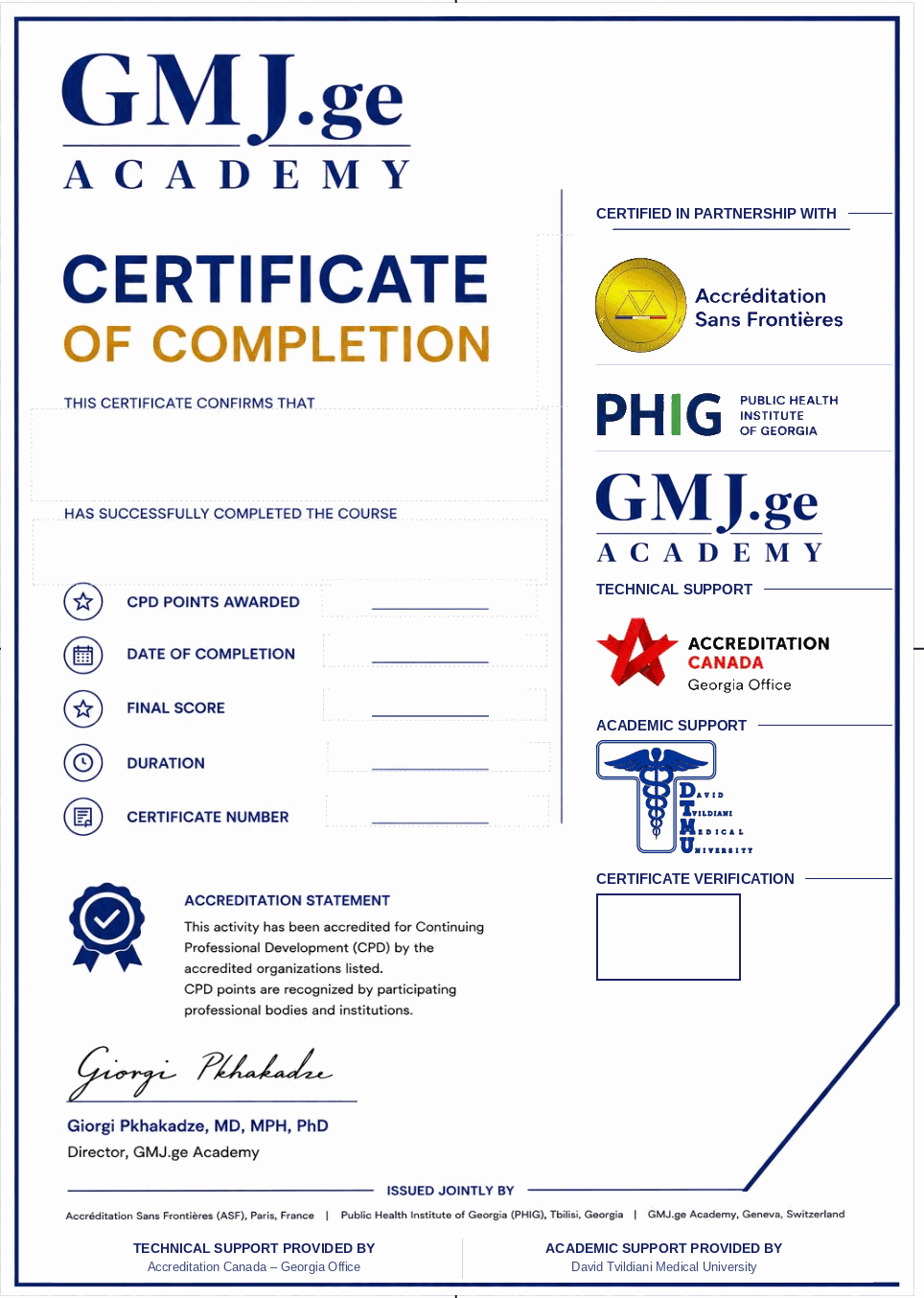
The course is delivered fully online through the GMJ Academy platform in a self-paced format, with an estimated study commitment of six to eight hours including interactive case analyses, structured readings, and a final knowledge assessment. Successful completion of the summative assessment with a score of 75% or above awards a GMJ Academy certificate of completion, qualifying for continuing medical education (CME) and continuing professional development (CPD) credit in accordance with the standards of the Scientific-Practical Center for CME of Georgia.




- ISO 15189:2022 requirements — L-18.

